
Executive Summary
This memorandum delineates a definitive, non-linear macro-historical analysis of Pfizer Inc. Characterized as a multi-generational case study in corporate life-cycle decay, our quantitative modeling maps the resolution of a 63-year long-wave expansion cycle initiated in fiscal year 1968.
We validate the current structural reversal from the April 2025 capitulation floor of $21.00, projecting a final, intensive capital accumulation phase driving equity values to a distribution apex of $80.00 by late-2032. Consequent to this cyclical exhaust, we project a multi-decade, irreversible systemic decompression, compressing equity to a terminal liquidation value of $5.00 and below by the 2060s, effectively dissolving the entity into industrial history.
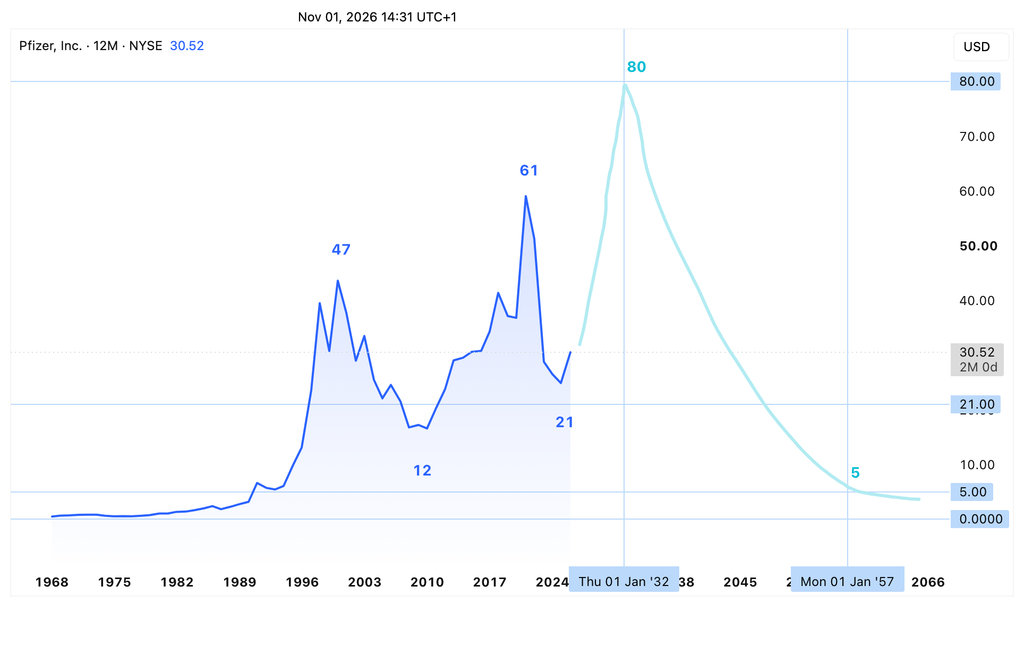
Phase I: The Oncology Consolidation & Final Supercycle Blow-Off — The Path to $80.00 (2026–2032)
The projected intermediate appreciation to $80.00 represents the final monetization window of the classic, small-molecule and biologic operational architecture:
1. Antibody-Drug Conjugate (ADC) Hyper-Monetization
Pfizer’s legacy capital deployment—most notably the $43 billion acquisition of Seagen—will achieve maximum regulatory and commercial velocity through the late 2020s. The commercialization of next-generation, targeted oncology platforms will yield unprecedented free cash flows to the firm (FCFF), temporarily masking the broader systemic patent cliff facing its legacy portfolio and driving institutional multiple expansion.
2. Metabolic Scaling and Capital Restructuring
By resolving previous clinical hurdles in oral GLP-1 and metabolic therapeutics, Pfizer will capture up to 20% of the global obesity market by 2031. At peak margin realization (2031–2032), the corporate treasury will execute an aggressive capital retirement program, utilizing hyper-inflated cash reserves to buy back outstanding float and artificially compounding Earnings Per Share (EPS) toward the $80.00 target matrix.
Phase II: The Genomic Displacement and Terminal Decay — The $5.00 Melt-Down (2032–2060s)
The subsequent 30-year secular collapse to $5.00 represents a profound macroeconomic and biotechnological regime shift that invalidates the concept of legacy mass-market pharmacology:
Structural Disintermediation via Programmable Medicine
By the mid-2030s, the paradigm of treating systemic diseases via reactive chemical or protein-based inputs will be fully superseded by in vivo genetic editing platforms. Advanced, open-source CRISPR-descendant architectures will allow for localized, preventative genomic modification, effectively eradicating chronic disease states prior to clinical manifestation.
Pfizer’s massive physical infrastructure (chemical synthesis factories, centralized cold-chain logistics hubs) will face structural write-downs, mutating into stranded assets.
Open-Source Decentralization & Molecular Bio-Printing
By 2045, the traditional pharmaceutical business model based on patent exclusivity will collapse due to regulatory shifts and the democratization of molecular synthesis. The commercialization of localized bio-printing arrays will allow municipal healthcare networks and personal decentralized AI interfaces to synthesize therapeutic compounds on-demand via open-source protocols.
The erosion of international patent enforceability renders Big Pharma’s core competitive edge and intellectual property vaults completely obsolete.
The Debt-Service Trap & Historical Dissolution
During its multi-decade decline, Pfizer will experience severe structural margin compression. Attempts to acquire emerging genomic tech-firms will lock the company into a permanent debt-service spiral, leading to a structural degradation of its credit profile to speculative tiers.
Following the permanent elimination of equity distributions, institutional capitulation will grind the stock down to its physical liquidation residual of **$5.00 and below by the 2060 horizon**, marking the terminal velocity of industrial obsolescence.