
Executive Summary
This memorandum outlines a non-linear, multi-phase valuation scenario for Ethereum (ETHUSDT). Distinguishing programmable settlement layers from static bearer assets, this analytical framework models the intersection of near-term decentralized finance (DeFi) leverage flushes, global liquidity contractions, and long-term computational utility.
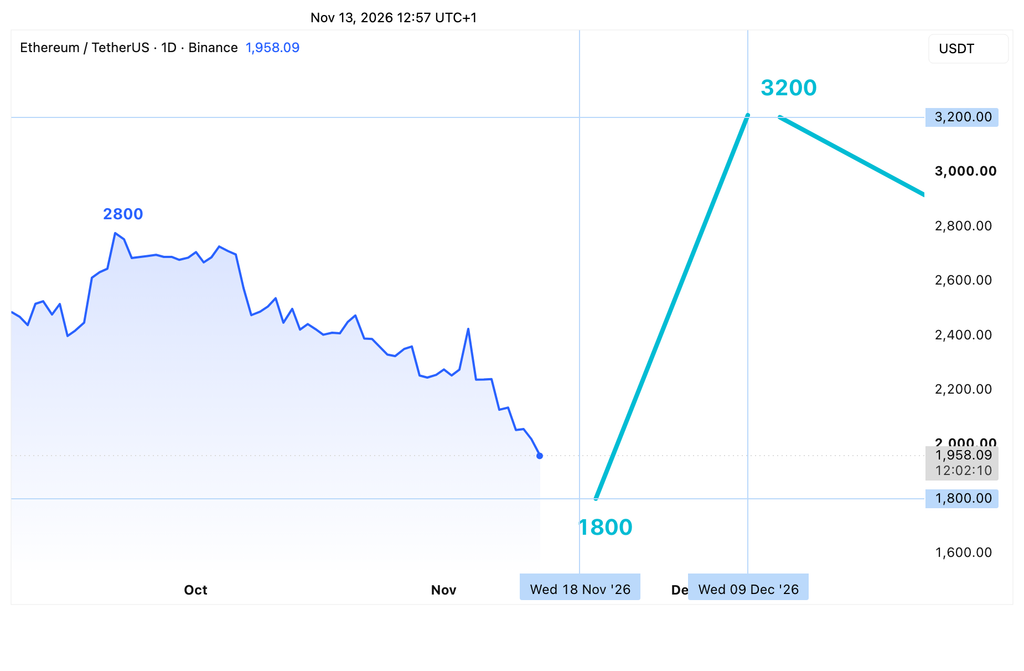
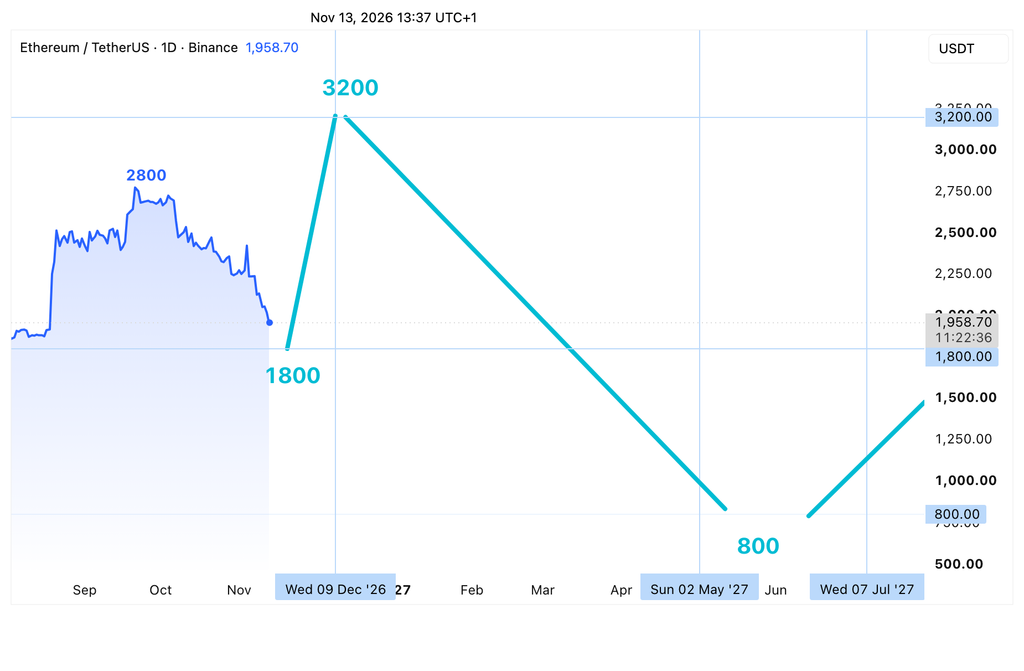
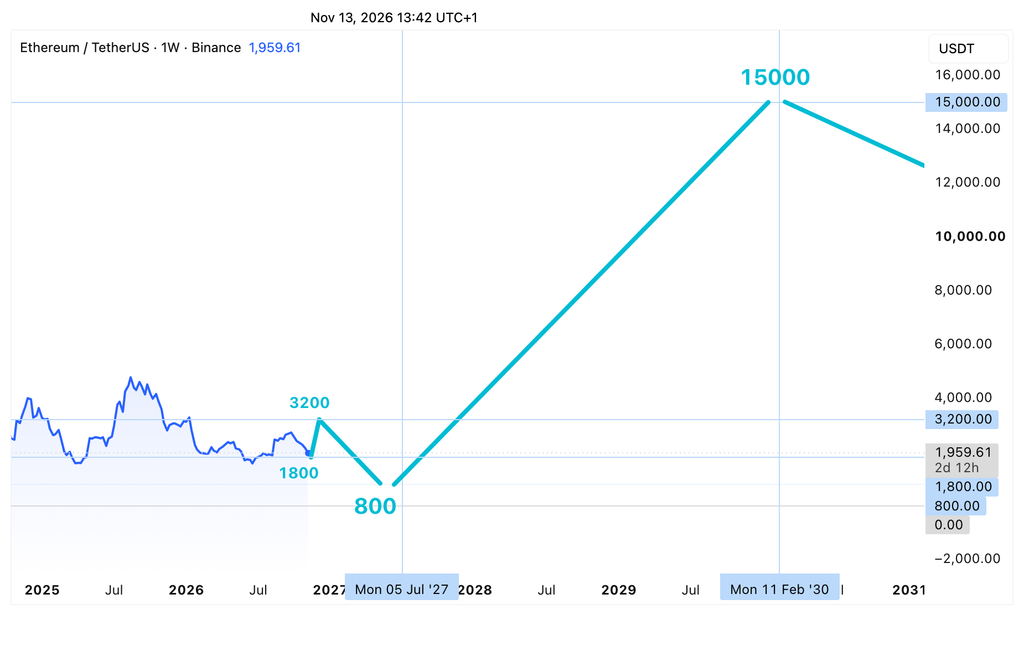
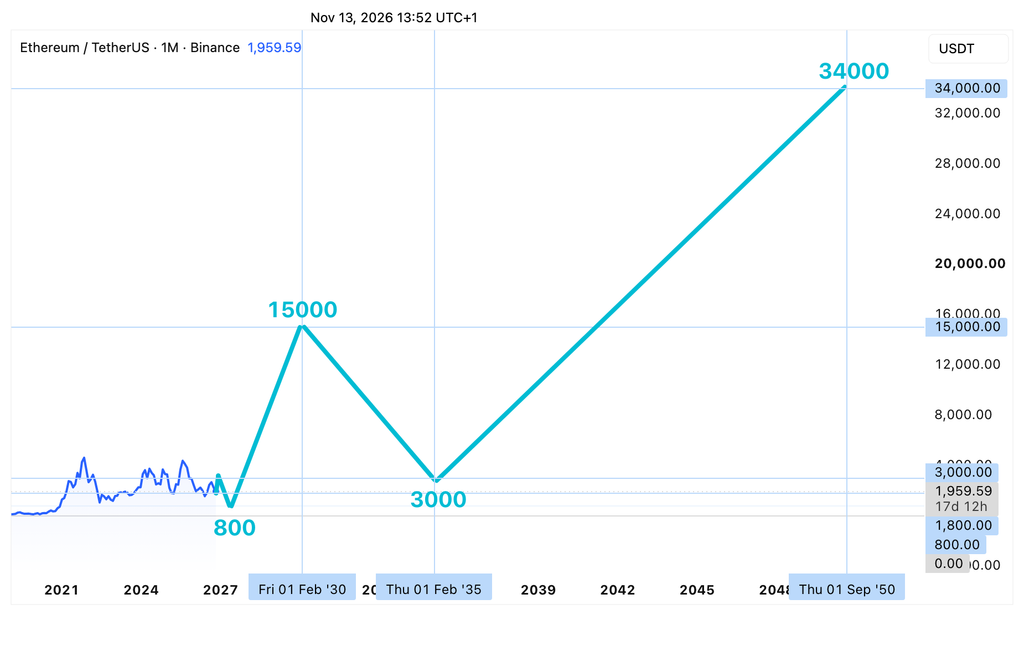
Under this hypothetical trajectory, price action completes an immediate cascade liquidation toward $1,800 within a 7-day window, triggering a synchronized year-end rebound to $3,200–$3,300 by mid-December 2026. Following this impulse, a broader macro-liquidity shock is modeled to drive a corrective flush to $800 by Q2 2027, where price consolidates for a two-to-three-month accumulation period. From this structural floor, institutional Real-World Asset (RWA) tokenization is projected to propel ETHUSDT to $15,000 by 2030. Consequent to an intermediate maturation pullback toward $3,000 around 2035, Ethereum’s protocol adaptability secures its survival as a foundational settlement layer for autonomous machine economies, targeting valuations exceeding $30,000 by the 2050s.
Phase I: DeFi Cascade and Year-End Beta Rotation — $1,800 to $3,300 (Nov–Dec 2026)
The immediate tactical trajectory is governed by on-chain collateral mechanics and cross-asset beta rotation:
1. The 7-Day Liquidation Flush ($1,800)
The rapid descent toward the $1,800 threshold reflects the triggering of automated liquidation cascades across decentralized lending protocols (such as Aave and Sky) alongside perpetual futures deleveraging. Clearing this concentrated cluster of over-leveraged collateral resets funding rates and removes structural overhead supply.
2. Synchronized December Rebound ($3,200–$3,300)
As Bitcoin initiates its year-end recovery impulse, institutional allocators and algorithmic market makers rotate capital into higher-beta digital infrastructure. Constrained liquid supply—driven by high staking participation ratios—amplifies upward price elasticity, propelling ETHUSDT back into the $3,200–$3,300 resistance band by mid-December 2026.
Phase II: Macro Liquidity Contraction and Institutional Base — $800 (Q2–Q3 2027)
The corrective pullback to $800 in Q2 2027 and subsequent multi-month consolidation represent a cyclical revaluation of Layer-1 fee economics amidst global macro tightening:
- Risk-Off Outflows and L2 Fee Compression: Tightening global liquidity in early 2027 prompts institutional outflows from spot exchange-traded products. Simultaneously, the migration of user activity to low-cost Layer-2 rollups temporarily compresses mainnet fee burn, fostering a market narrative of structural revenue decay.
- The Two-to-Three-Month Accumulation Floor ($800): Extended price stability near $800 allows sovereign wealth entities and financial conglomerates to accumulate core protocol equity at distressed multiples, recognizing Ethereum’s underlying security budget as essential infrastructure for upcoming capital-market digitization.
Phase III: Global RWA Tokenization and Post-Quantum Resilience — $15,000 (2027–2030)
The sustained expansion from the $800 accumulation base to $15,000 by 2030 models the transition of decentralized ledgers from speculative venues into core global financial plumbing:
- Institutional Settlement Standard: By 2030, sovereign debt instruments, equities, and real estate registries migrate onto public-permissioned rollup architectures anchored to Ethereum’s mainnet finality.
- Cryptographic Agility: Unlike rigid legacy protocols, Ethereum’s modular governance and account-abstraction framework enable a coordinated transition to quantum-resistant signature schemes. This technological adaptability attracts capital rotating out of cryptographically vulnerable digital assets, driving valuation expansion toward $15,000.
Phase IV: Infrastructure Maturation and Autonomous Machine Economy — $3,000 to $30,000+ (2035–2050s)
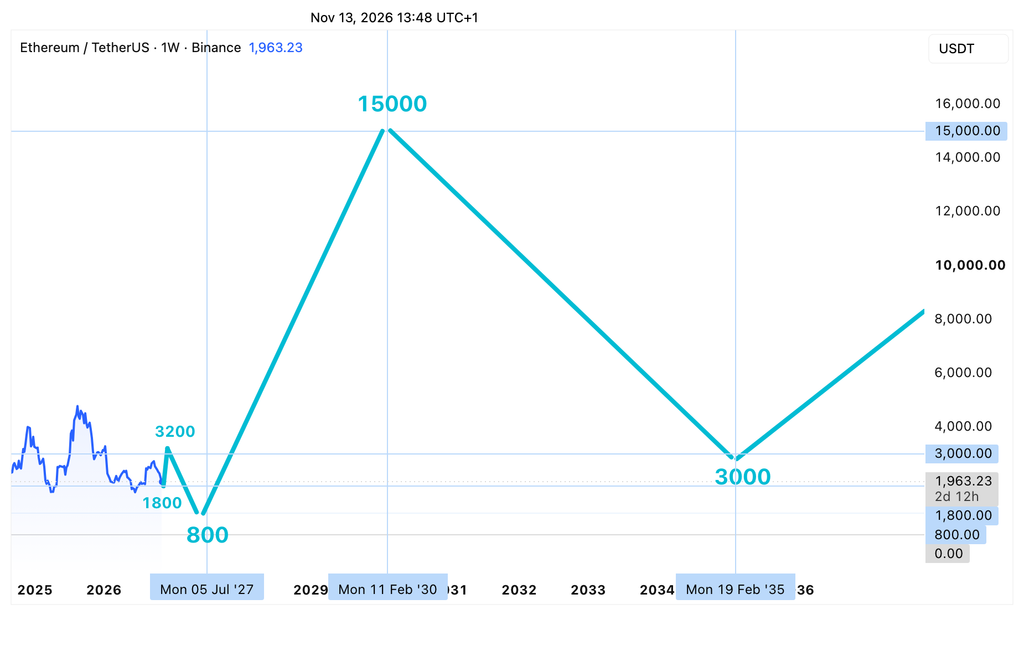
The final multi-decade arc—comprising a corrective normalization toward $3,000 around 2035 followed by a secular ascent exceeding $30,000 by the 2050s—reflects the maturation of decentralized compute into a global utility:
Regulatory Normalization (2030–2035)
Strict compliance frameworks and competition from sovereign digital settlement networks compress speculative valuation multiples, re-rating ETH as a regulated utility infrastructure asset.
Mean reversion toward a fundamentally grounded baseline of ~$3,000 by 2035.
Autonomous AI Settlement Layer (2035–2050s)
Proliferation of autonomous AI agents, decentralized physical infrastructure networks (DePIN), and machine-to-machine micro-commerce requires permissionless, programmable settlement outside legacy banking rails.
Exponential transaction volume drives continuous fee burn and monetary velocity, propelling valuations above $30,000 by the 2050s.