
Executive Summary
This memorandum outlines a non-linear, multi-phase valuation scenario for Bitcoin (BTCUSDT). Moving beyond linear adoption extrapolations, this analytical framework models the intersection of near-term derivative market mechanics, macroeconomic liquidity cycles, and long-term cryptographic obsolescence risks.
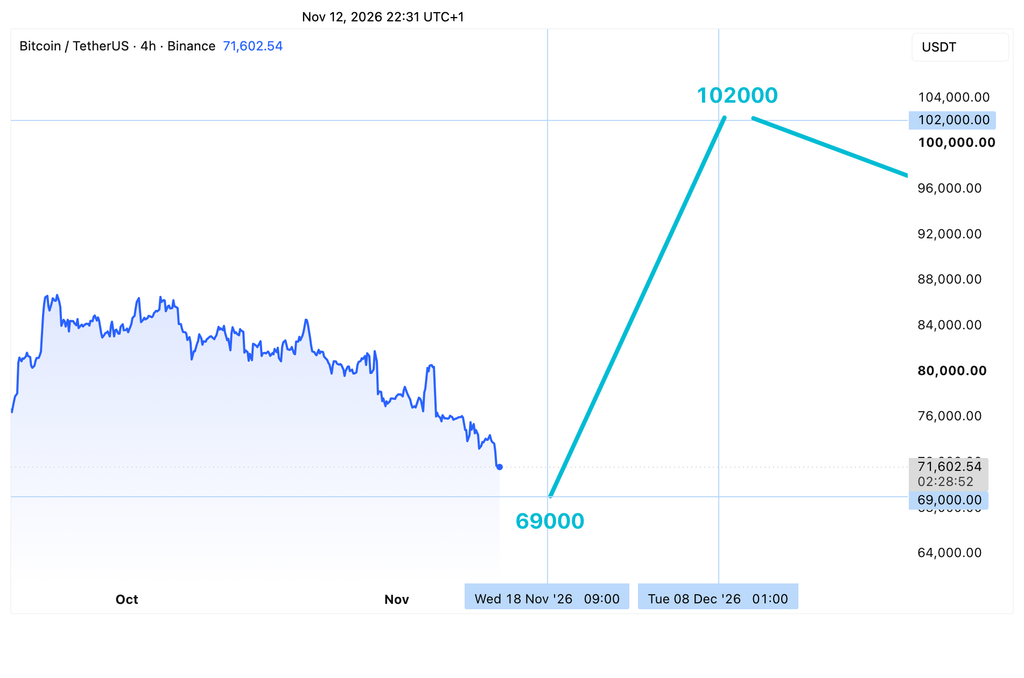
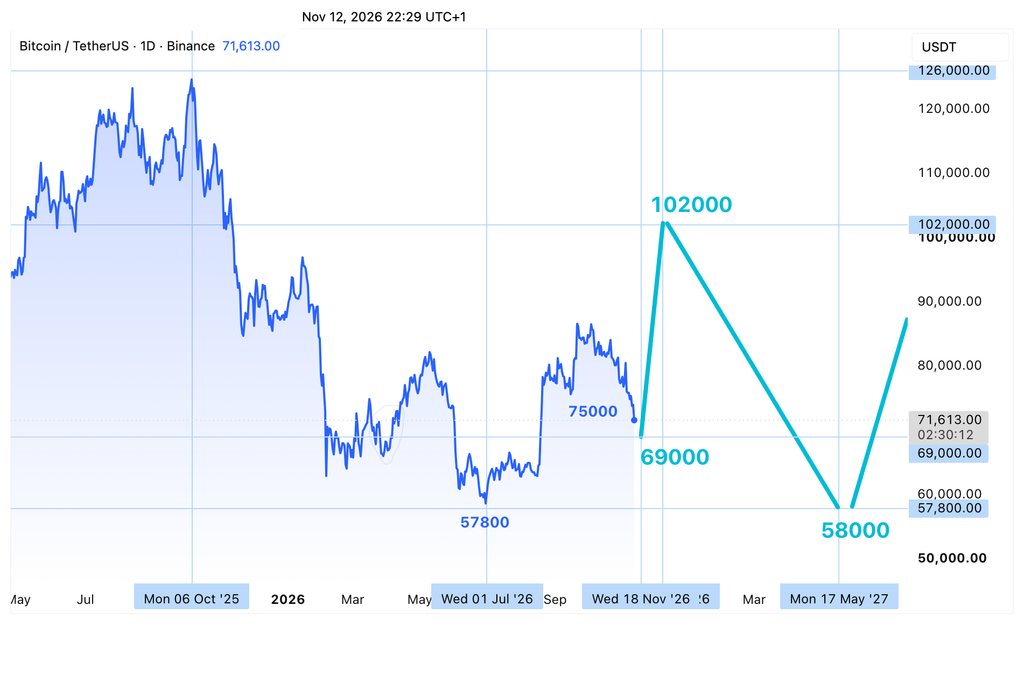
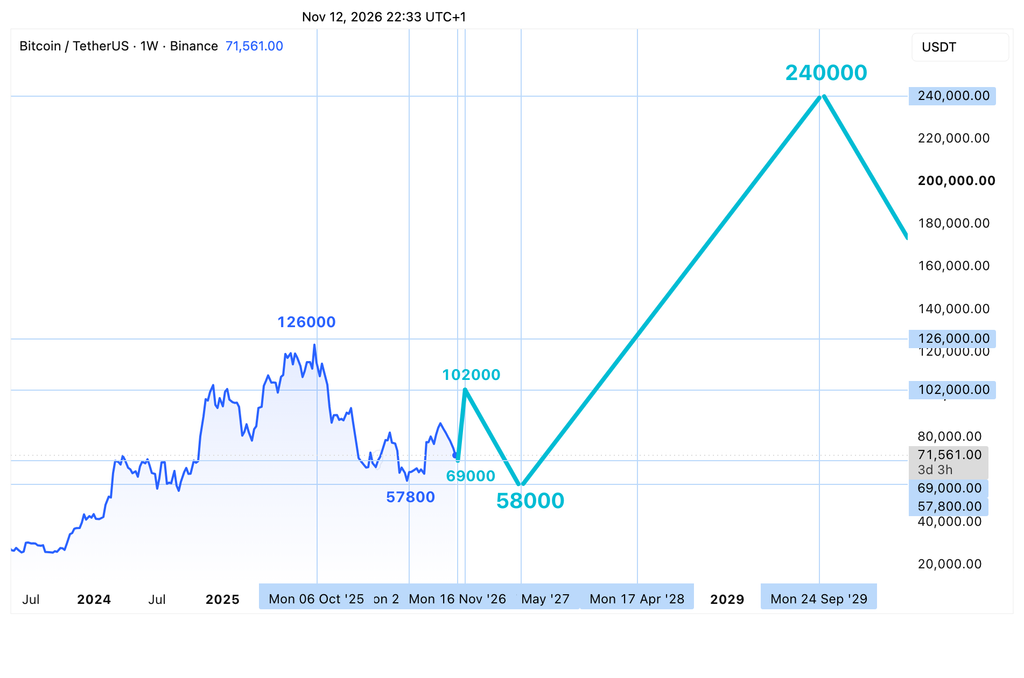
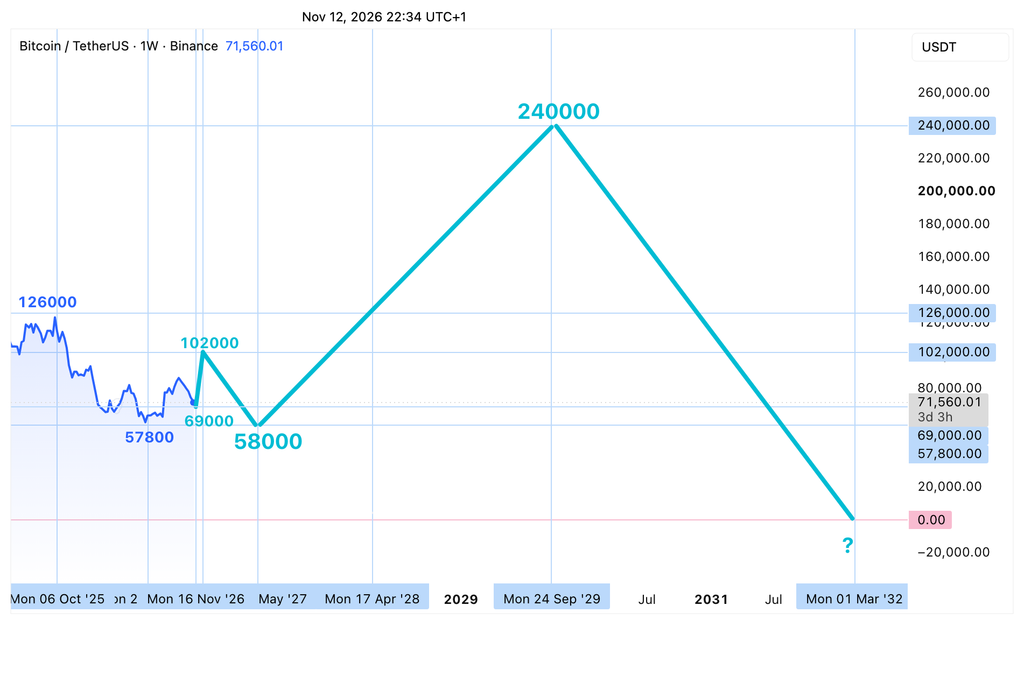
Under this hypothetical trajectory, price action stabilizes near the $69,000 inflection zone, initiating a tactical year-end rebound toward $100,000–$102,000 by mid-December 2026. Following this impulse, a broader liquidity contraction is modeled to drive a corrective retracement to $58,000 by summer 2027, establishing the base for a final, speculative blow-off apex near $240,000. Consequent to this cyclical peak, the framework evaluates a severe structural repricing toward near-zero valuation bounds by 2032, contingent upon unresolved post-quantum security vulnerabilities and miner incentive decay.
Phase I: Tactical Rebound and Corrective Flush — $69,000 to $58,000 (2026–2027)
The intermediate trajectory is governed by institutional portfolio rebalancing, derivatives positioning, and macro-liquidity tightening:
1. Year-End Short Squeeze and ETF Rebalancing ($100,000–$102,000)
Stabilization around the $69,000 support threshold reflects the clearing of over-leveraged long positions. As institutional asset managers execute year-end portfolio rebalancing through spot exchange-traded products, concentrated buying pressure combined with short-covering in perpetual futures markets can drive a rapid tactical rally toward the $100,000–$102,000 resistance band by mid-December 2026.
2. Macro Liquidity Contraction and Shakeout ($58,000)
In the first half of 2027, renewed tightening in global sovereign debt markets and elevated real yields are modeled to trigger a cross-asset risk-off rotation. High-beta digital assets face institutional profit-taking to meet collateral requirements elsewhere. This corrective wave compresses BTCUSDT toward the $58,000 structural support zone by summer 2027, aligning with post-halving production cost baselines and purging speculative retail sentiment prior to the final expansion phase.
Phase II: The Speculative Blow-Off Apex — The Ascent to $240,000 (Post-2027)
The surge from the $58,000 accumulation floor to $240,000 represents the culmination of supply-inelasticity dynamics and late-cycle monetary hedging:
- Supply Shock and Institutional Allocation: Following consecutive block-reward reductions, the liquid float available on centralized exchanges reaches historic lows. Renewed monetary expansion and sovereign wealth diversification into non-sovereign bearer assets create an acute demand-supply imbalance, propelling valuations into a parabolic distribution peak near $240,000.
Phase III: Structural Obsolescence and Cryptographic Tail Risks — Horizon 2032
The projected downward trajectory toward near-zero bounds by 2032 models the realization of existential technological and game-theoretic vulnerabilities inherent to the protocol’s legacy architecture:
| Risk Vector | Technical & Economic Mechanism | Valuation Impact (2028–2032) |
|---|---|---|
| Post-Quantum Cryptographic Vulnerability (Q-Day) | Advancements in fault-tolerant quantum computing threaten the Elliptic Curve Digital Signature Algorithm (ECDSA) and SHA-256 hashing. Failure to execute a timely, consensus-driven hard fork exposes dormant and active public keys to compromise. | Erosion of foundational trust in ledger immutability, triggering institutional divestment. |
| Security-Budget Compression | As block subsidies diminish exponentially with each halving, network security relies entirely on transaction fee revenue. Insufficient on-chain fee volume lowers the economic cost of executing a 51% state-reorganization attack. | Degradation of network finality and heightened vulnerability to state-level or adversarial disruption. |
| Regulatory & Sovereign Displacement | Enactment of strict capital controls alongside the rollout of programmable Central Bank Digital Currencies (CBDCs) restricts fiat on/off-ramps, while capital rotates back into tangible physical commodities. | Severe liquidity fragmentation, compressing market capitalization toward nominal residual levels by 2032. |
Analytical Caveat
While this scenario maps a complete lifecycle from institutional adoption peak to technological obsolescence, actual market realization remains strictly contingent upon the pace of quantum hardware development and the capacity of the open-source developer ecosystem to deploy quantum-resistant cryptographic upgrades ahead of systemic threats.